What Is 3D For
in the World Model Era?

Generative world models, spatial reasoning, and action

Jiatao Gu

3D in the Era of World Models · ECCV 2026 Workshop · September 9

Why we used 3D in the first place

Image generation improved before coherent video generation did.
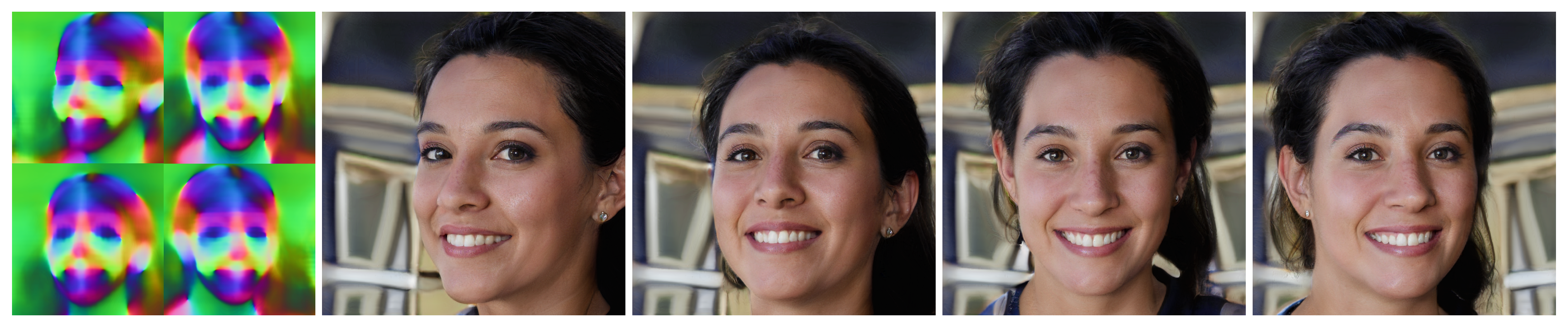
Image-level priorsGood individual images
→
Views can disagreeNo shared scene constraint
→
Add 3D structureTie generated views to one world
StyleNeRF2021 · ICLR 2022
StyleNeRF: geometry and four views of the same generated face

Build 3D into the generator.
Learn from 2D images; control the camera.

DreamFusion2022 · ICLR 2023
DreamFusion official gallery: generated objects rendered from changing viewpoints

Use an image prior to optimize 3D.
A frozen 2D diffusion model guides a NeRF.
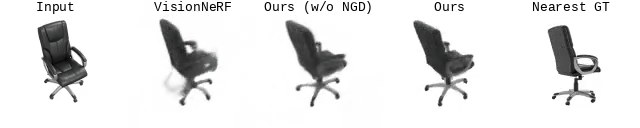
NeRFDiff2023 · ICML 2023
NeRFDiff official comparison: input, VisionNeRF, without NGD, full method, and ground truth

Couple diffusion across views.
NeRF guides jointly refined virtual views.

Use image-generation knowledge to produce a consistent world.

Making better use of image priors

Make spatial structure part of what the generator learns and predicts.

Learn a reusable 3D prior

SSDNeRF · ICCV 2023
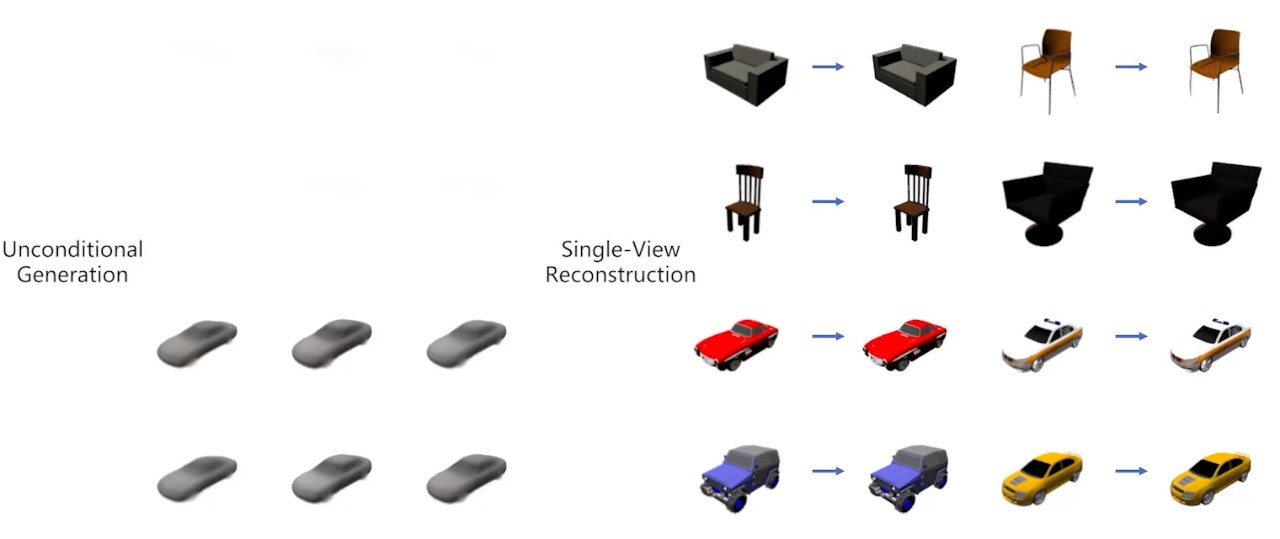
SSDNeRF official demonstration of unconditional generation and single-view reconstruction
Multi-view images → a generative 3D field
Jointly learn scene codes, a NeRF decoder, and a diffusion prior.

Reuse image/video priors directly

WVD · RGB–XYZ prediction · CVPR 2025
RGBWVD generated RGB view 0; XYZ stores global 3D coordinatesWVD generated RGB view 2; XYZ stores global 3D coordinatesWVD generated RGB view 4; XYZ stores global 3D coordinatesXYZWVD generated XYZ view 0; XYZ stores global 3D coordinatesWVD generated XYZ view 2; XYZ stores global 3D coordinatesWVD generated XYZ view 4; XYZ stores global 3D coordinates
Pretrained diffusion → joint RGB + XYZ
Represent geometry as images; adapt the model to predict both.

The goal: turn image-level generative capability into
3D-consistent generation for world modeling.

Chen et al. · SSDNeRF · Zhang et al. · World-consistent Video Diffusion · Official video and paired RGB/XYZ predictions

What if consistency could simply be learned?

Learn spatial and temporal correlations directly in the generative model.
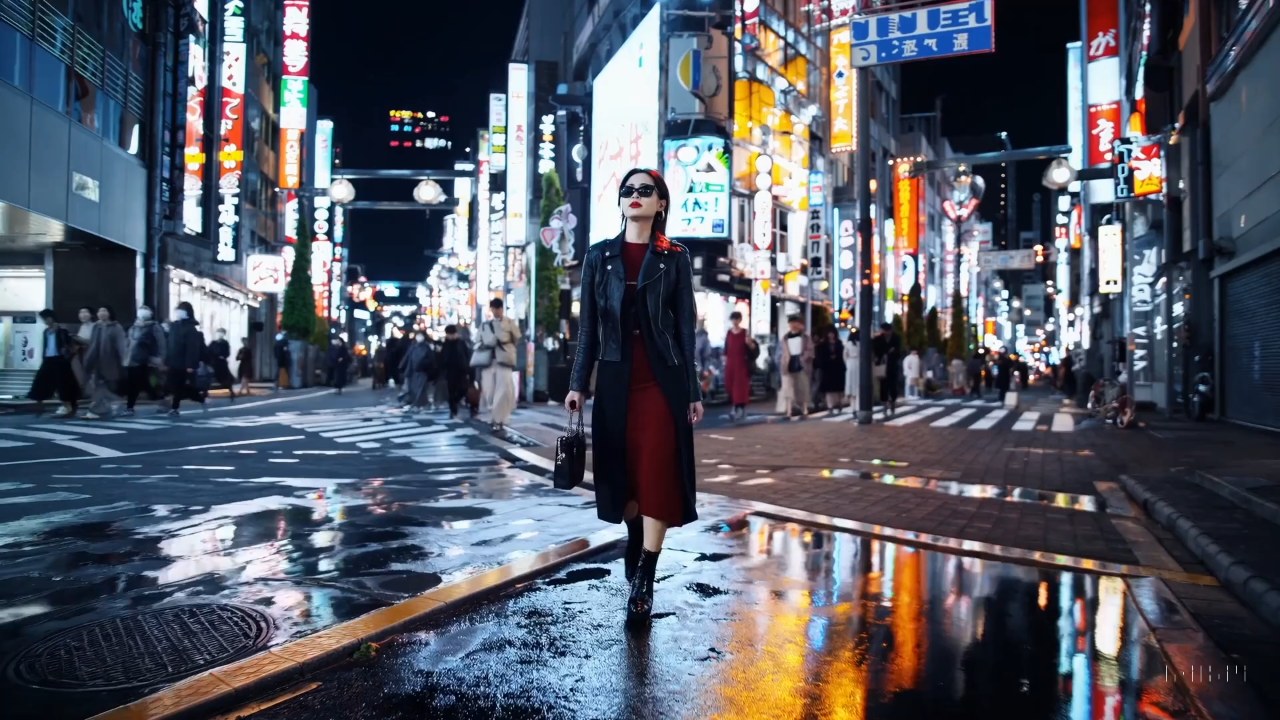
Sora · joint video diffusion · 2024
Joint spatiotemporal modeling
[ t₁ ↔ t₂ ↔ t₃ ↔ t₄ ]
Denoise a video’s latent spacetime patches together.
Self Forcing · autoregressive video diffusion · 2025
Autoregressive generation
[ past ] → [ next chunk ] → …
Generate each continuation conditioned on the past.

Expressive generative models + sufficient data and compute

3D structure can be learned implicitly.

OpenAI · Sora technical report, 2024 · Huang et al. · Self Forcing, 2025 · Conceptual diagrams; official video samples

We are entering the world model era

Still frame from this slide’s video
Input camera
Still frame from this slide’s video
Input hand pose

Controls specify a candidate motion.
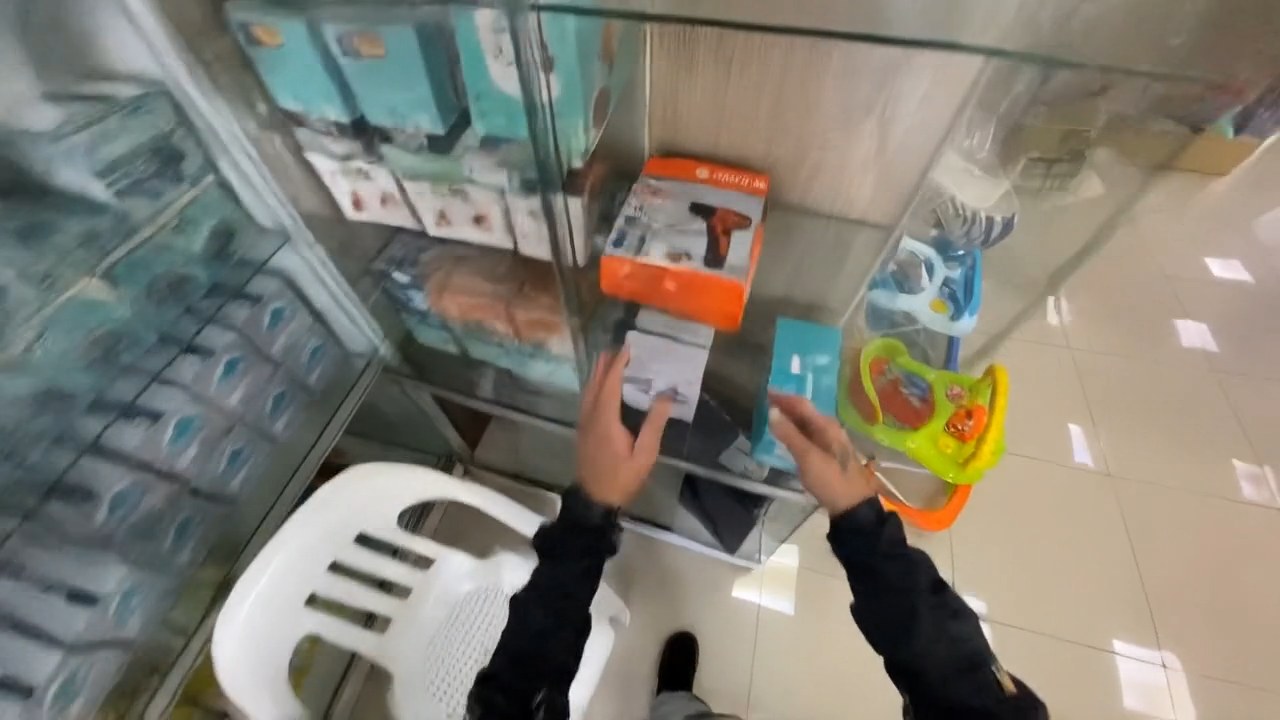
Still frame from this slide’s video
Cosmos 3 · generated future video

Generative models predict how the world changes under a chosen motion.

Worlds we can interact with
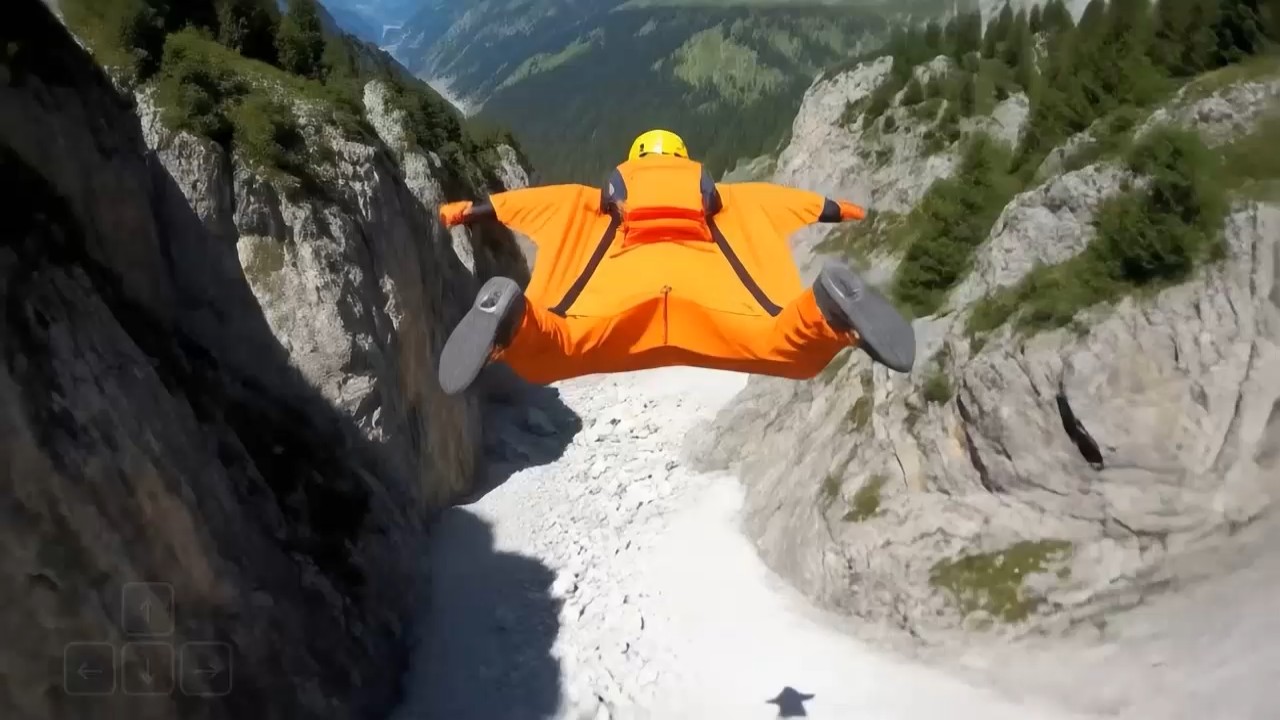
Still frame from this slide’s video
Genie 3 · action-conditioned exploration

The next view depends on what the user does.

Do we still need explicit 3D?
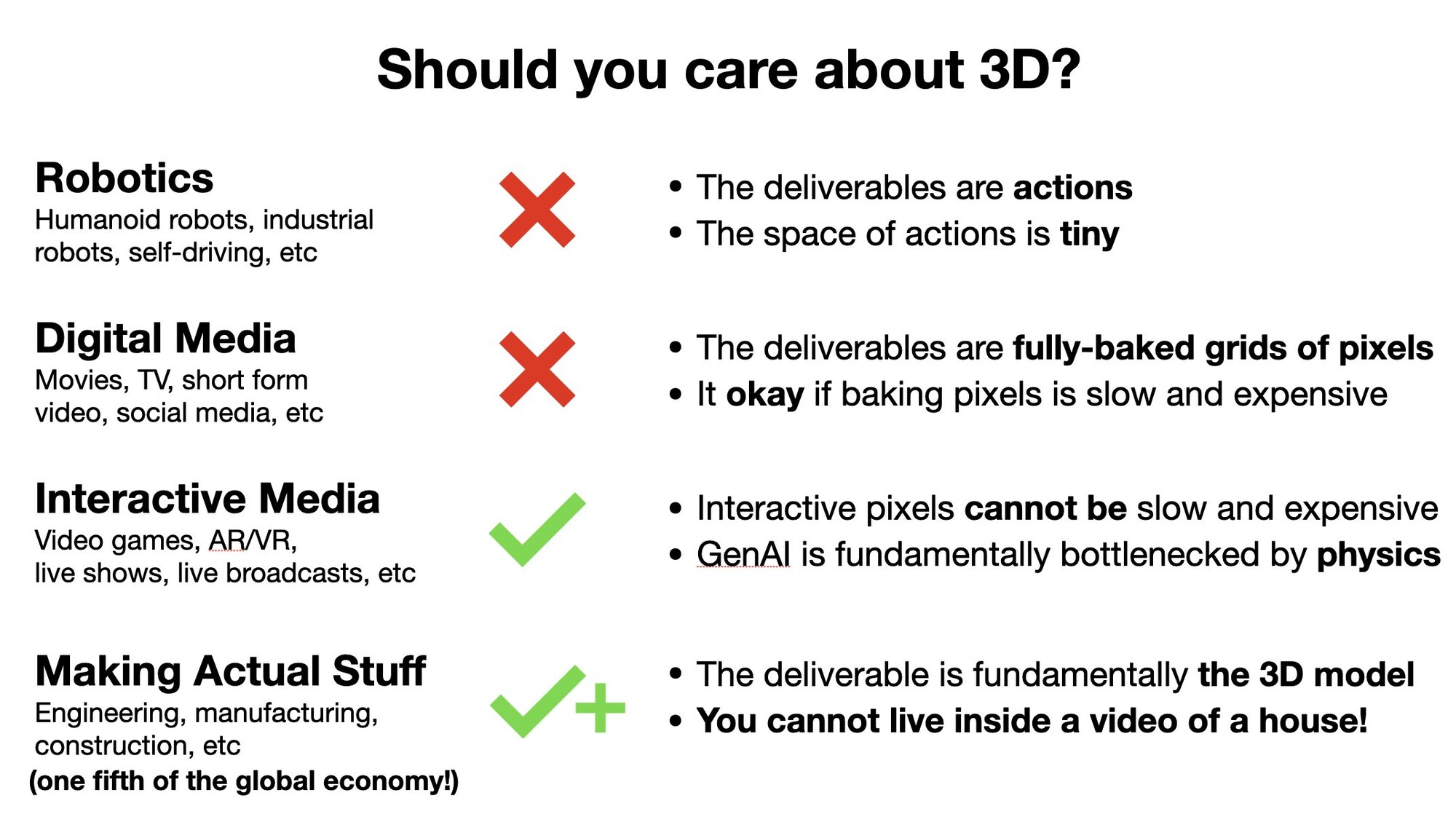
Jon Barron’s original scorecard: robotics and passive digital media marked no; interactive media and physical manufacturing marked yes

If the deliverable is pixels or actions, why prescribe a 3D representation?

Do we still need explicit 3D?
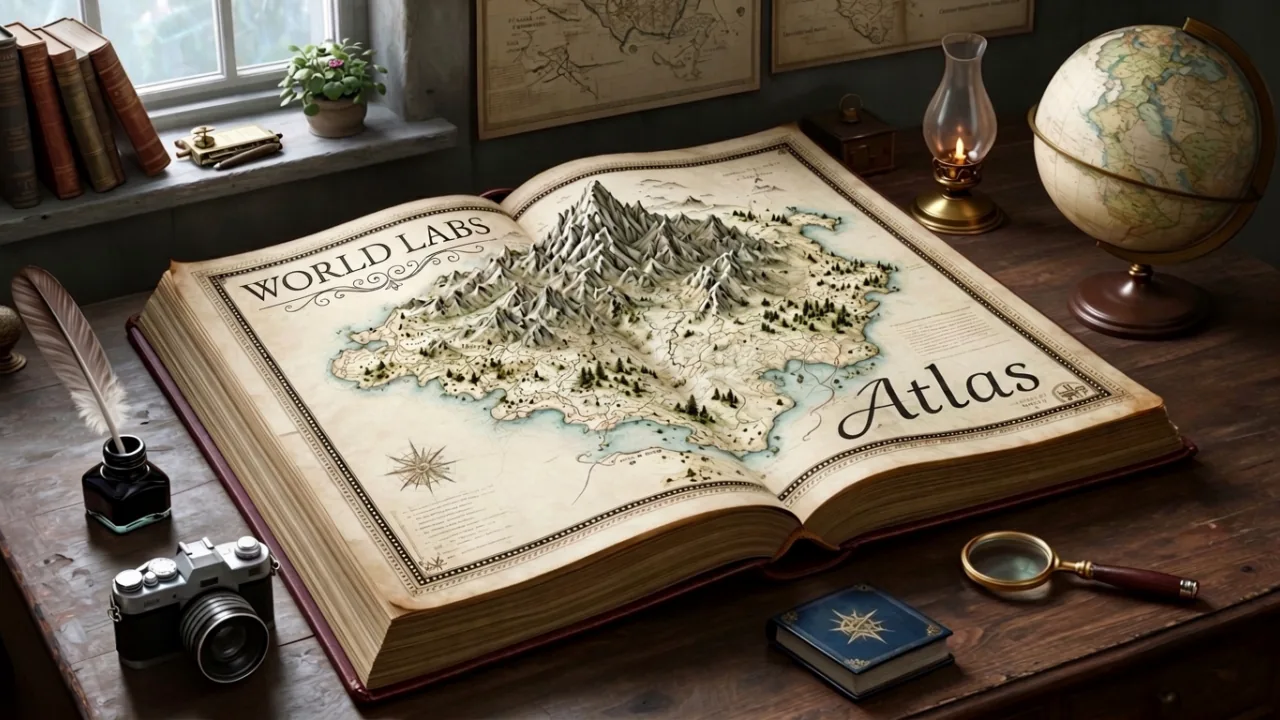
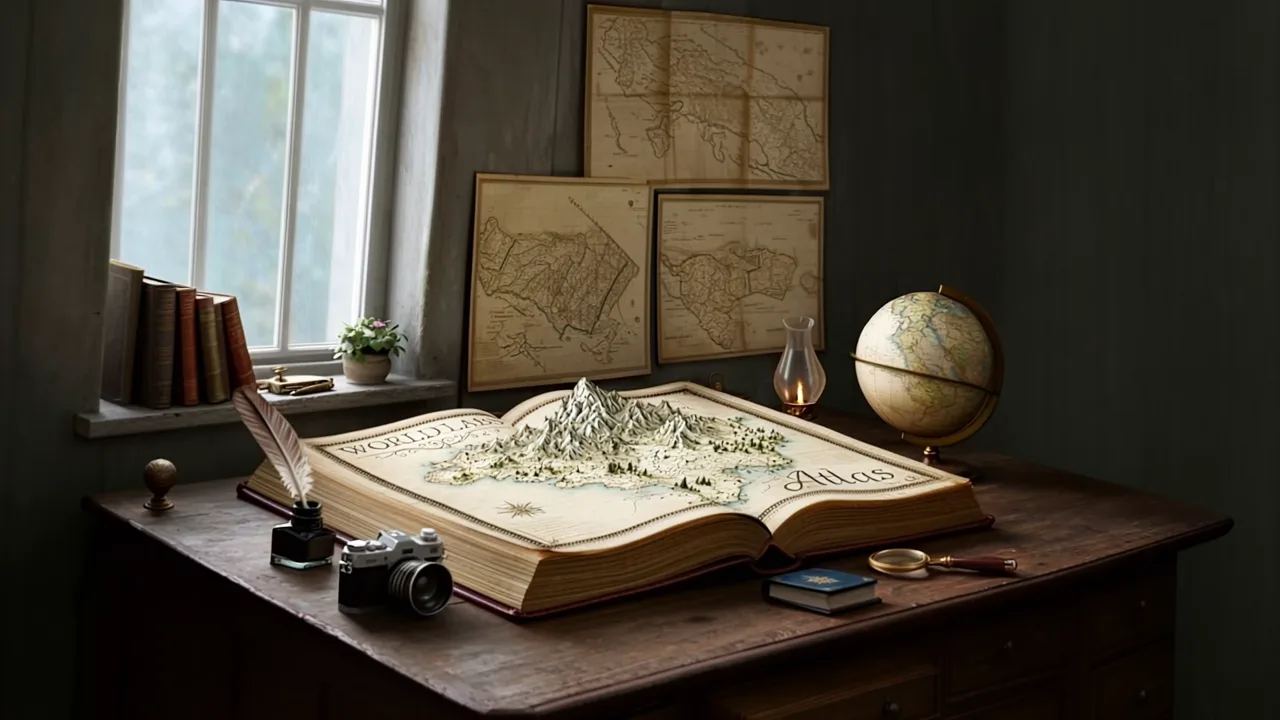
Official Atlas input: an open atlas and globe on a desk
One reference image
Still frame from this slide’s video
Atlas · views generated along a camera path

A spatial experience can be generated without first delivering a complete 3D scene.

HYPOTHESIS
Autoregressive video diffusion + camera control + large-scale supervised data
3D may help generate the training data.

We can now simulate worlds in RGB
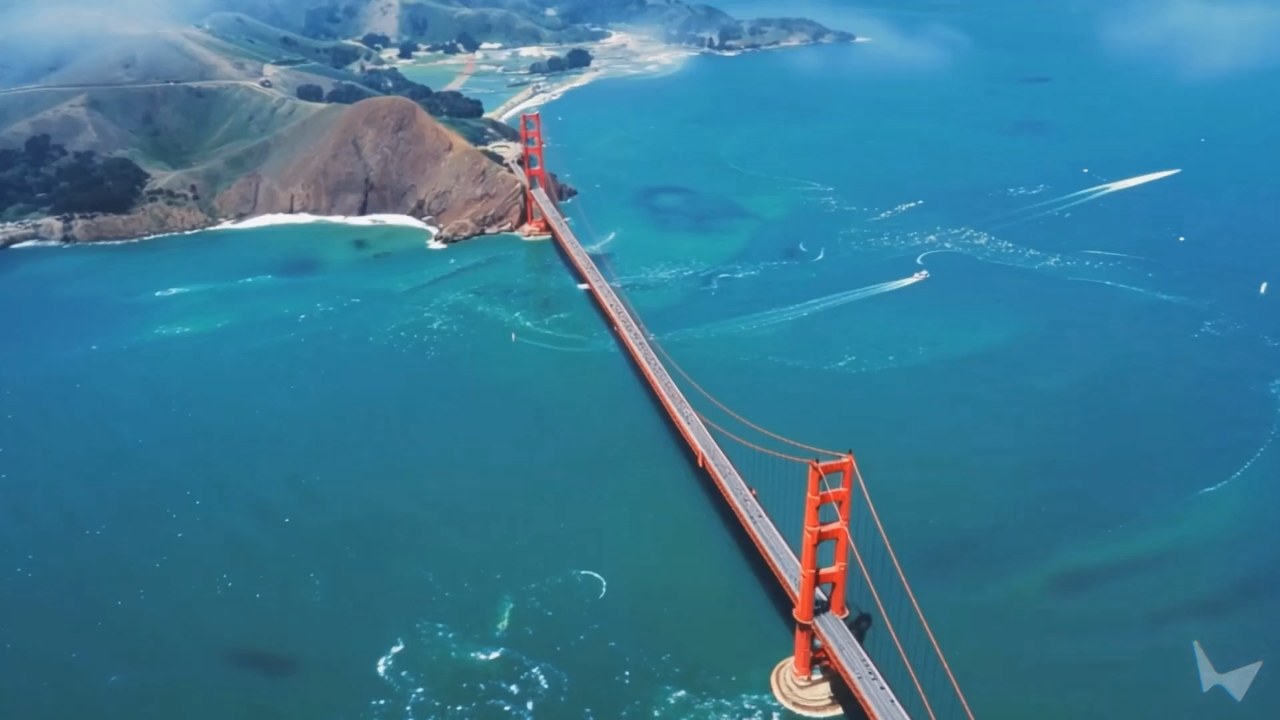
Still frame from this video
Atlas · generated worlds
Still frame from this video
Genie 3 · interactive exploration
Still frame from this video
Cosmos 3 · controlled futures

Compelling spatial experiences can emerge through RGB generation.

How can these predictions help an agent decide what to do?

What about reasoning?

How do these predictions help an agent choose what to do?

Atlas desk scene with a book, globe, and camera, reused here to pose spatial reasoning questions
The same scene, now with questions about its structure.
Where are things?

Relative positions, distances, and occlusions.

What changes if I act?

How objects and observations change under an action.

Which motions are possible?

Reachability, clearance, and collision.

Does explicit 3D help us answer these questions?

World Labs · Atlas reference image · Illustrative reasoning questions

The model can reason from context

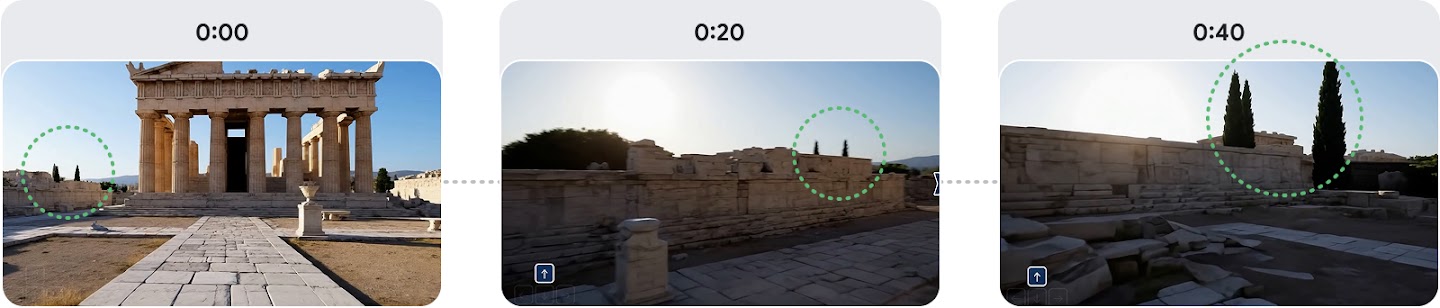
Genie 3 official image sequence revisiting a place at 0, 20, and 40 seconds
The visual history contains evidence about the same world over time.
Context

Past frames, actions, and the current question

→
Learned model

Infer spatial relationships from the available evidence

→
Answer or prediction

Location, visibility, or a possible next move

Spatial understanding can stay implicit in the model and its context.

As history grows: keep more context, compress it, or retrieve what matters.

Google DeepMind · Genie 3 revisit example · Diagram: a general context-based reasoning route

3D as an efficient way to reason

Much of our reasoning is in service of acting in the physical world.

Observe through images Appearance depends on the viewpoint reason Act in physical space obstacle a path with clearance
Metric distance

How far does the hand need to move?

Physical contact

Do the hand and object actually meet?

Collision and reachability

Can the motion be executed in the world?

3D gives reasoning an explicit interface to the space where actions have consequences.

Conceptual illustration · a motivation for explicit spatial reasoning, not a claim that geometry alone solves control

3D as an efficient way to reason

Reasoning over time needs memory.

Memory in context

t₁
t₂
t₃
…
tₙ
→

The observation history keeps growing.

Keep moreCompressSelect / retrieve

The model learns what persists and what matters from data.

More history also requires a way to manage memory.

Memory in world coordinates

A · same identityB · stable geometryC · updated positionxyz

Keep the same spatial identities.
Update their state as new evidence arrives.

3D provides a structural prior for persistence.

The same world need not be stored again at every timestep.

Conceptual argument · memory indexed by observations or by persistent spatial state

3D as an efficient way to reason

Stable structure, evolving objects.
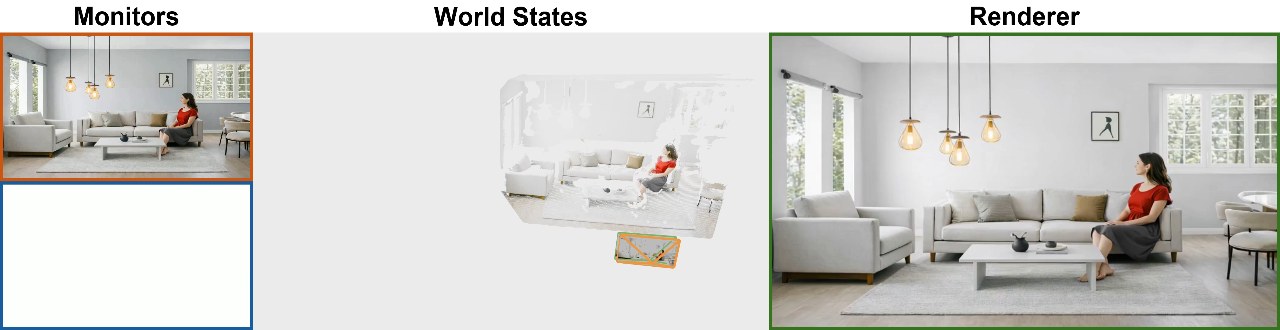
LiveWorld official video: dynamic monitors, persistent 3D world state, and rendered observation
LiveWorld · a persistent scene with dynamics that continue out of view
Retain the background

Reuse geometry in world coordinates.

Evolve the entities

Update changing objects over time.

Render the current view

Query the state when the observer returns.

The world state can persist beyond the current context window.

3D as an efficient way to reason

Reuse spatial reasoning across time.
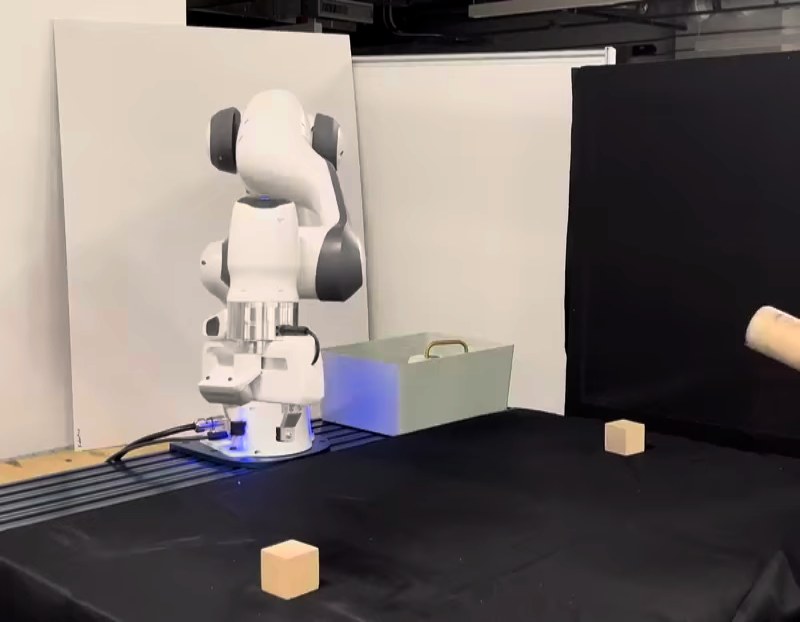
Still frame from this video
External example · NVIDIA cuRobo · depth-based mapping and motion generation
Keep the scene state

A 3D map carries geometry across observations.

Update what changes

New depth revises the current map.

Reuse the same queries

Check distance and collision for each new plan.

The time changes; the meaning of a spatial query stays the same.

3D as an efficient way to reason

A persistent memory layer for world prediction and action prediction.

Observations
Observation history

New evidence

→
3D / object memory
Geometry
Features
Identity
Uncertainty

State · features · uncertainty

Persist · update · reuse

→
World prediction

Views and future states

Action prediction

Motion and constraints

Learn over persistent state, then reuse the model across time.

Next: spatial motion · spatial constraints · persistent memory

Research hypothesis · shared persistent spatial state for world and action models

Two ways to use 3D for action

I’ll focus on PointAction and OmniGuide.

3D as an action interface

PointAction
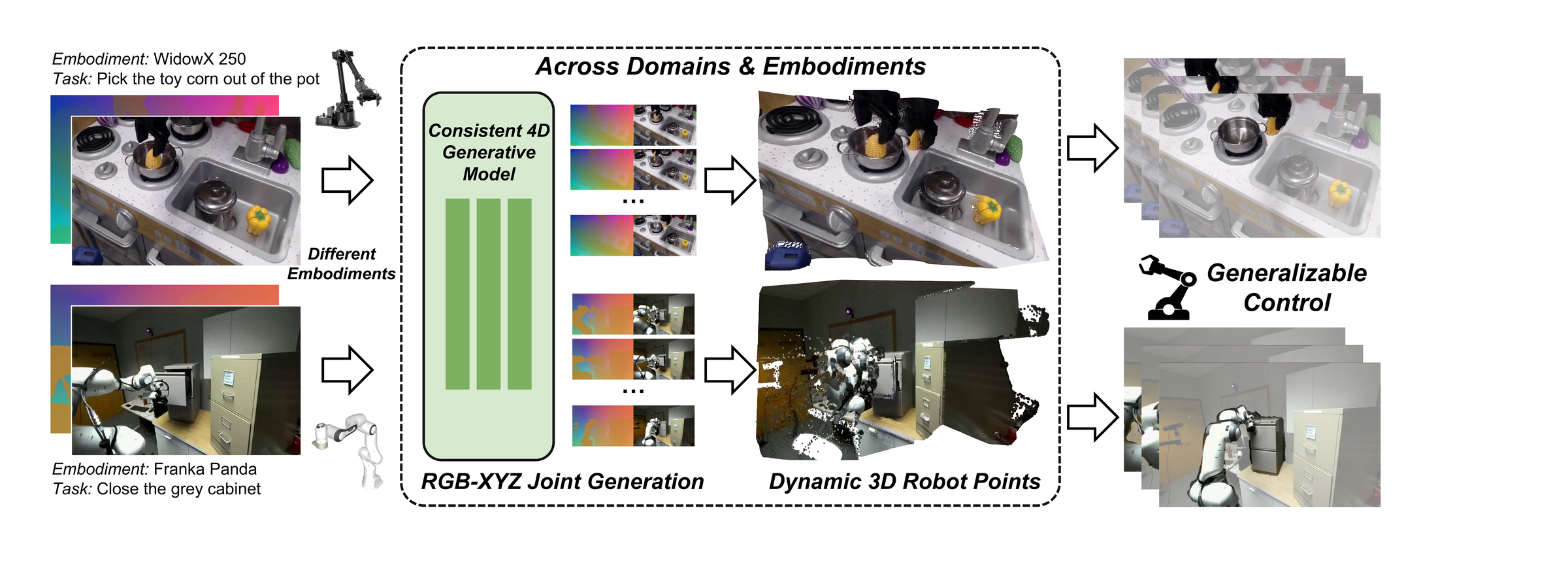
PointAction overview: predict dynamic point trajectories and decode them into robot actions

Connect predicted 3D motion to robot control.

Video prediction → 3D point motion → robot actions

3D as a guidance field

OmniGuide
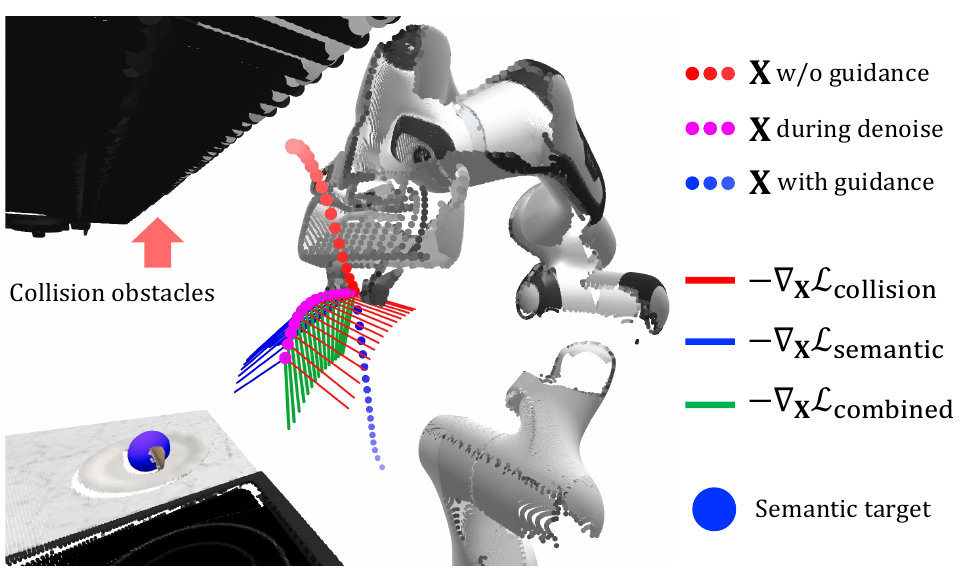
OmniGuide spatial fields: attraction to goals, repulsion from obstacles, and their combination

Use spatial constraints to guide a pretrained VLA.

VLA + 3D fields → guided actions

A spatial representation the model can predict and reason with.

Using world predictions to guide actions

Given an observation and an instruction, imagine a plan the robot can follow.

WAM

World Action
Model

World model

Predict a visual future

→
Video plan
→
Action generation

Controls aligned with
the predicted future

WPAM

World Point
Action Model

PointAction

World model

Jointly predict
RGB + XYZ

→
3D point plan

Explicit robot point motion

→
Action generation

Decode point motion
with the robot state

Make the world model’s plan explicit in 3D before translating it into action.

How does a video plan become an action?

PointAction · from imagined motion to robot control
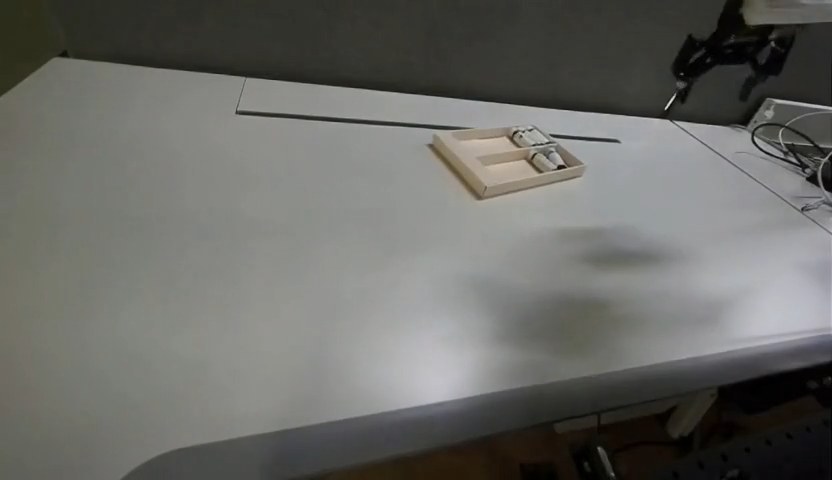
Generated PointAction RGB robot rollout
A video model can predict a plausible manipulation.

The action decoder still has to infer…

Metric motion

How far should the gripper move in 3D?

Contact geometry

Where does the gripper meet the object?

Robot controls

Which commands realize that motion?

Grounding RGB in control requires robot-specific action supervision.

3D motion gives us a common interface

Make the predicted motion explicit before translating it into controls.
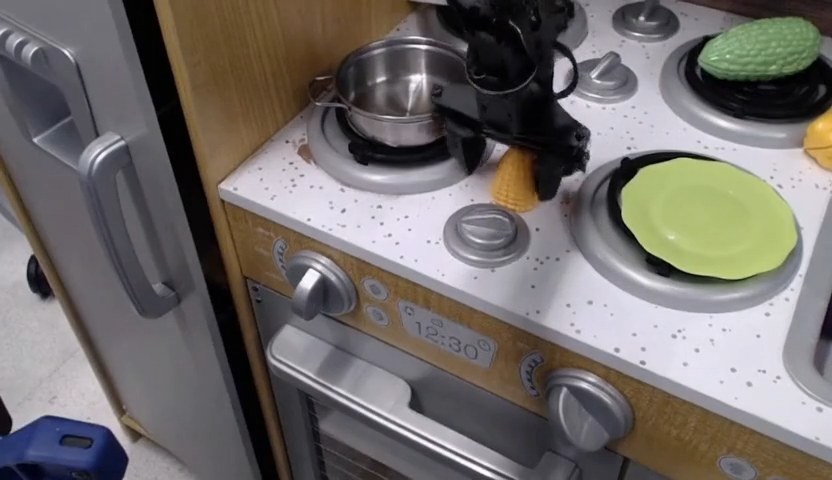
RGB · what the scene will look like
Jointly predicted Bridge RGB rollout
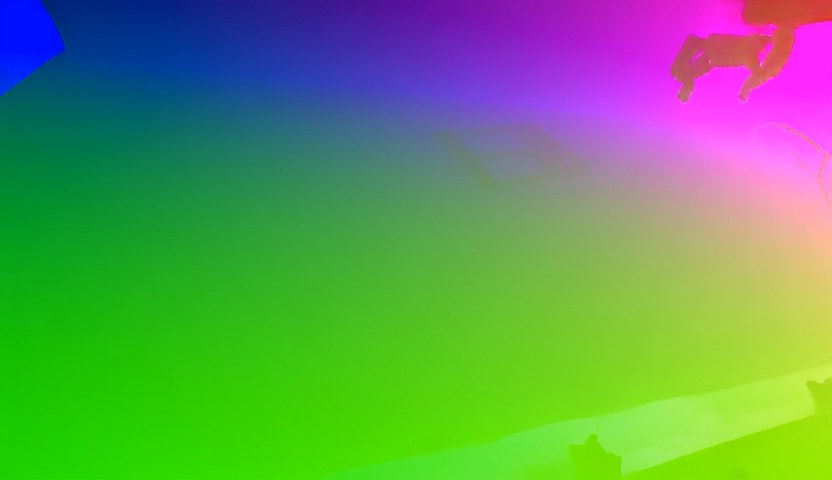
XYZ · where the geometry will move
Jointly predicted Bridge XYZ rollout
Metric coordinates

Expose spatial displacement over time.

Robot geometry

Select the moving robot surface for control.

A shared format

Represent motion without arm-specific action channels.

Predict how the robot should move; learn how this robot executes it.

Learn motion broadly, adapt control locally

Separate learning what should move from learning a robot’s control space.

PointAction shared RGB–XYZ prediction and robot point interface across different embodiments
Learn motion from video + geometry

Reconstruction and depth estimation provide point supervision without action labels.

Learn control from paired robot data

A small decoder translates point motion and robot state into that arm’s actions.

The bridge is 3D point motion: learnable from videos, usable for control.

Appearance and geometry, frame by frame
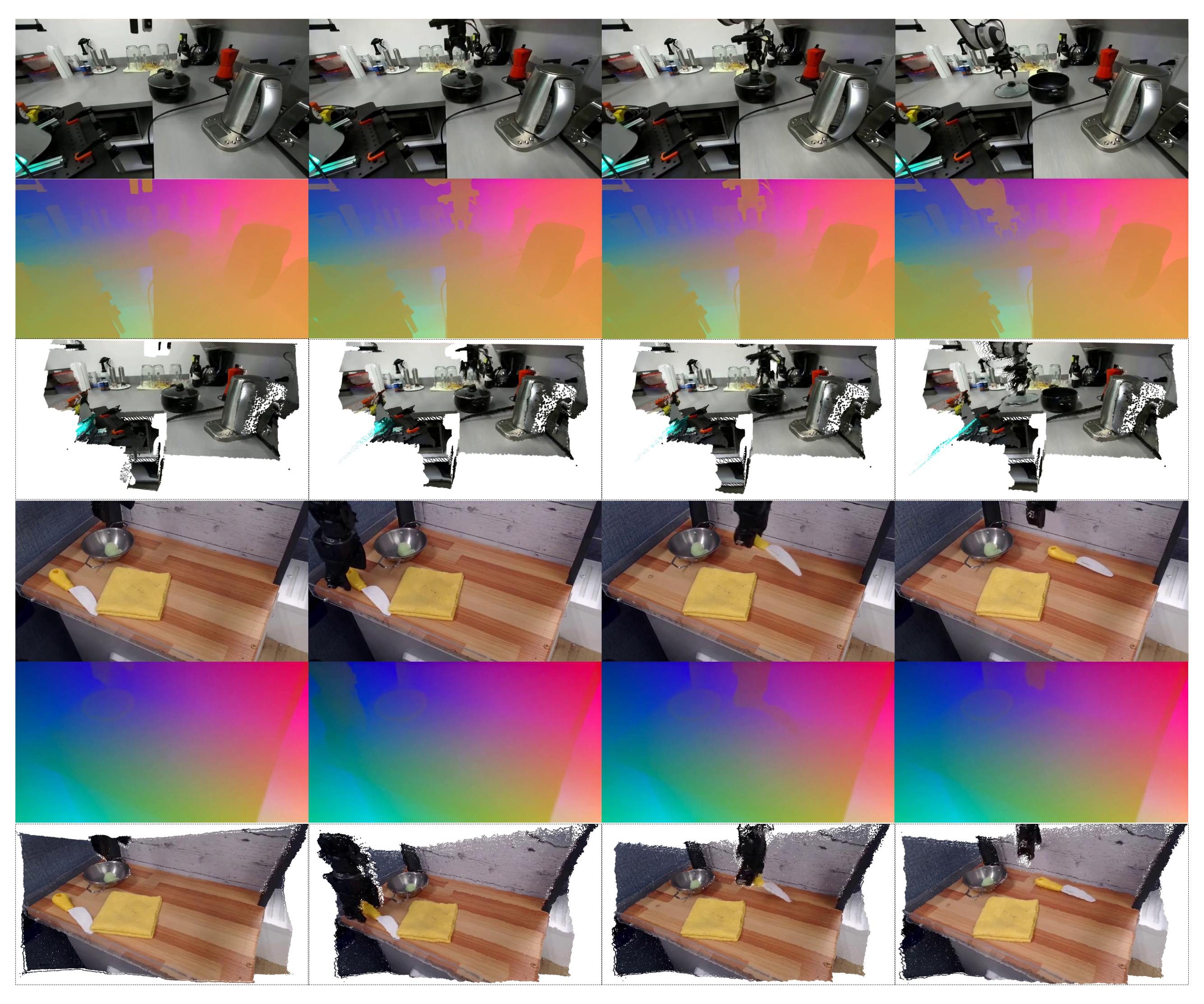
PointAction qualitative RGB and XYZ future prediction
RGB carries appearance. The model predicts how the scene will look.
XYZ carries spatial motion. Pointmaps expose where robot geometry moves over time.
Geometry becomes a control interface. The action decoder reads masked robot points.

The action decoder reads the robot’s 3D motion

Joint prediction

$u_t(p)=(x_p,y_p,z_p,\alpha_p)$

XYZ gives the 3D position associated with a pixel.

A sequence of pointmaps exposes spatial change over time.

Robot selection

$\tilde u_{\rm robo}=\tilde u_{xyz}\odot\tilde\alpha$

SAM 3 segments the predicted RGB with the prompt “robot”.

The mask comes from a separate segmentation pass.

The decoder receives action-relevant geometry. The full scene supports prediction; robot points provide the control interface.

From robot videos to an adapted policy

01

Robot videos

DROID + BridgeData V2

→

02

Add geometry

Stereo / monocular depth

→

03

Learn RGB + XYZ

Video modelRGBXYZ

Joint future prediction

→

04

Adapt to an arm

Post-train model + decoder

Video + geometry supervision

No paired action labels in pretraining

Paired demonstrations

20–50 per task

PointAction · Sec. 4.1–4.2 · Pretraining data: ~50K DROID + ~25K BridgeData V2 trajectories

First predict motion, then decode actions

$o$: RGB · $u$: XYZ + robot mask · $a$: actions · $s_t$: robot state · $l$: instruction

$\pi(\tilde o,\tilde a\mid s_t,o_t,l)\approx\int\pi_{\rm 4D}(\tilde o,\tilde u\mid o_t,l)\,\pi_{\rm dec}(\tilde a\mid\tilde u,s_t)\,d\tilde u$
Predict spatial motion. Sample future RGB and XYZ from the current image and instruction. Extract the robot points using the predicted RGB.
Decode executable actions. Condition an arm-specific action model on those point trajectories and the current robot state $s_t$.

A shared representation with target-arm adaptation of the predictive model and decoder.

PointAction, arXiv 2606.03943

Adapting a video model to predict RGB and XYZ
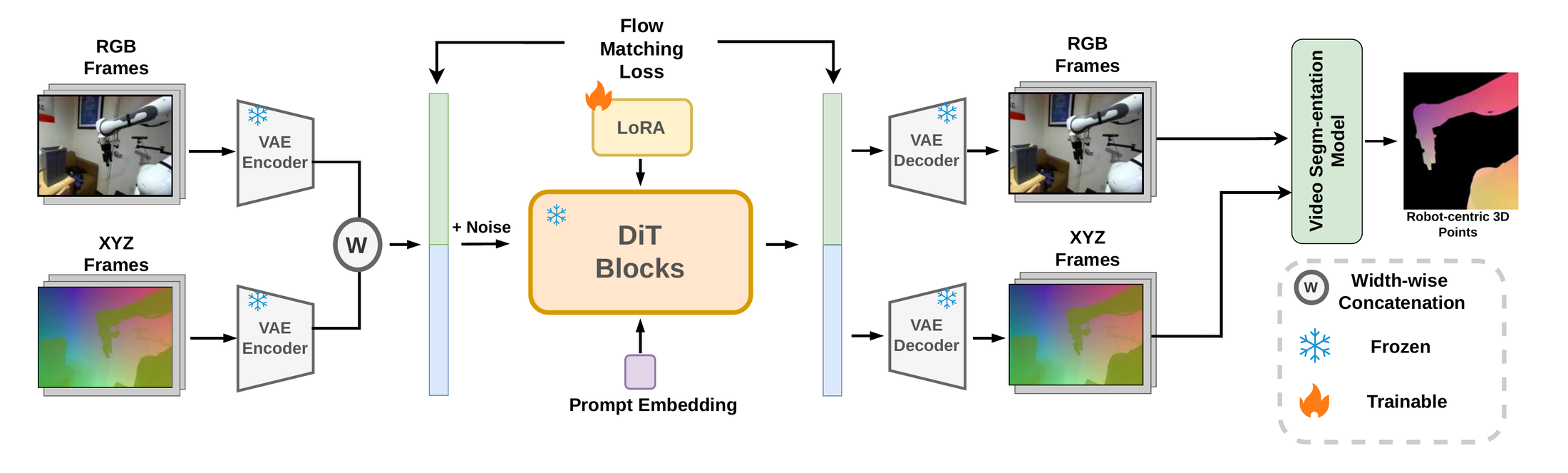
PointAction Stage 1 — joint RGB+XYZ DiT
Shared VAE, separate streams. Encode RGB and XYZ independently. Concatenate their latents along width, preserving the pretrained channel dimension.
Adapt the video prior with LoRA. Initialize from LVP. Keep the VAE and text encoder frozen and train joint RGB–XYZ prediction.
Joint spatial rollout. Predict future appearance and pointmaps together. A separate SAM 3 pass supplies the robot mask.
PointAction, arXiv 2606.03943

Turning point trajectories into robot actions
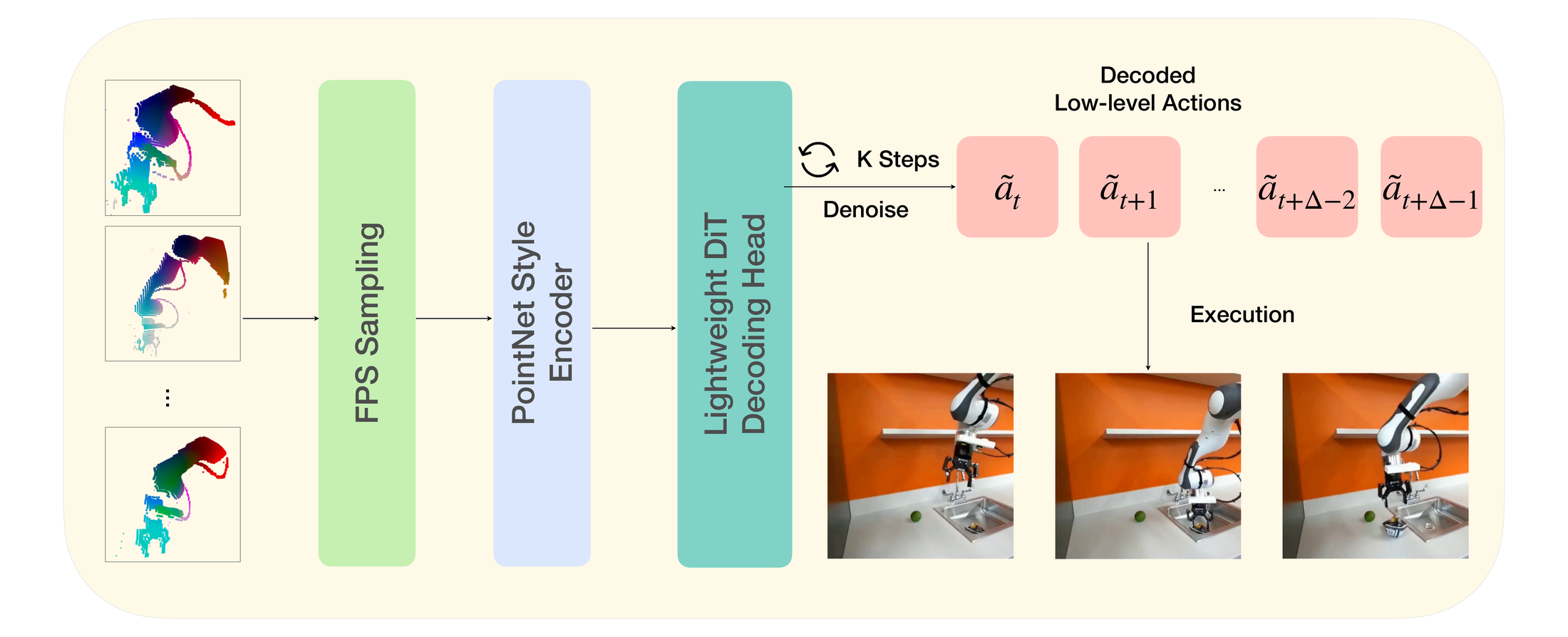
PointAction decoder
512 points per frame. Farthest-point sampling retains spatial coverage of the robot surface.
PointNet-style encoder. A shared MLP produces one geometric feature for each frame.
Action DiT. Match point features to action tokens. AdaLN injects the noise step and initial robot state.

Target-arm data supports RGB–XYZ post-training and decoder training; transfer is not zero-shot.

PointAction, arXiv 2606.03943

Training the action decoder

$P_i=\mathrm{FPS}(\tilde u_{{\rm robo},i},512),\qquad c_i=\Phi(P_i)$
$\mathcal L_{\rm dec}=\mathbb E\!\left[\left\|\epsilon'-\epsilon_\psi(a^{(j)},\{c_i\},s_t,j)\right\|_2^2\right]$
Per-frame conditioning. Concatenate each noisy action token with its point feature $c_i$.
Global conditioning. AdaLN injects the initial robot state $s_t$ and noise step $j$.
Chunk generation. Denoise all 49 actions together using 10 DDIM steps.

Simulation decoder: 6 Transformer blocks · hidden width 256 · 4 attention heads

Which geometry actually helps control?

RoboCasa365 sim, avg success (%), 100 rollouts per task.

Decoder inputIDOOD-Env
RGB only25.120.3
RGB + XYZ, robot only37.230.9
XYZ, full scene27.119.4
XYZ, robot + scene40.333.7
Post-hoc DA3 XYZ, robot only28.421.7
Jointly predicted XYZ, robot only47.744.1
Joint spatial prediction helps. Joint XYZ prediction outperforms post-hoc depth on the generated RGB.
More points need not help. The decoder benefits from focusing on action-relevant robot geometry.

In this setting, which spatial variables we expose changes the control result.

PointAction, arXiv 2606.03943

How good are the generated RGB and XYZ?
Bridge · RGB
Still frame from this slide’s video
Bridge · XYZ
Still frame from this slide’s video
DROID · RGB
Still frame from this slide’s video
DROID · XYZ
Still frame from this slide’s video

Generated RGB and corresponding dynamic XYZ pointmaps

DROID + BridgeData V2 · 300 held-out trajectories per dataset

MethodPSNR ↑SSIM ↑FVD ↓Chamfer L1 ↓
TesserAct12.230.4877460.389
4DNeX13.860.5428180.370
LVP19.610.816330—
Wan 2.1 14B14.530.674671—
Ours19.630.8213200.122

How well does the policy generalize?

RoboCasa365 · success (%) · 100 rollouts per task

SettingGR00T N1.7$\pi_{0.5}$VPPCosmosOurs
ID (10 seen)44.539.834.545.247.7
OOD-Env37.635.232.242.944.1
OOD-Task8.66.97.414.017.0
Seen tasks, new environments. PointAction reaches 44.1% under changes in backgrounds and textures.
New tasks remain difficult. Success is 17.0% on unseen tasks in seen environments.

Spatial grounding helps control. Task generalization remains a separate challenge.

Adapting to two new robot arms

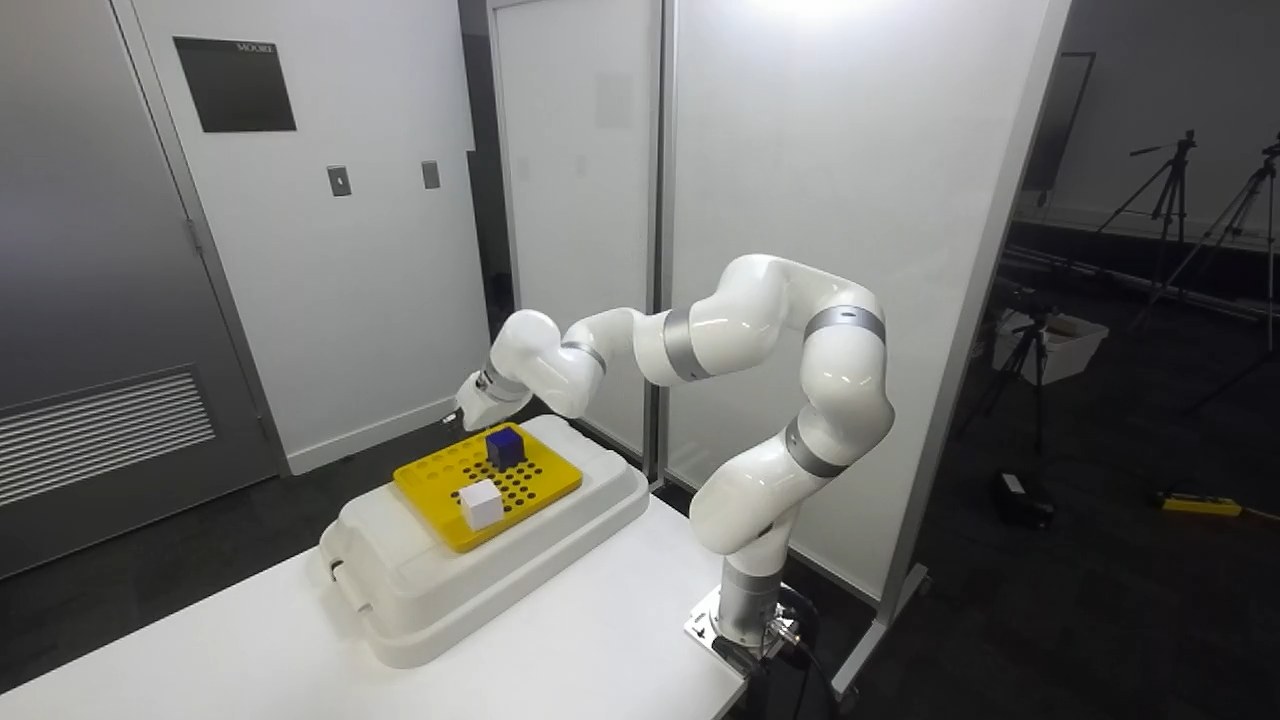
YAM and xArm7 — neither seen during 4D-video pretraining. Target-arm adaptation uses 20–50 expert trajectories per task.
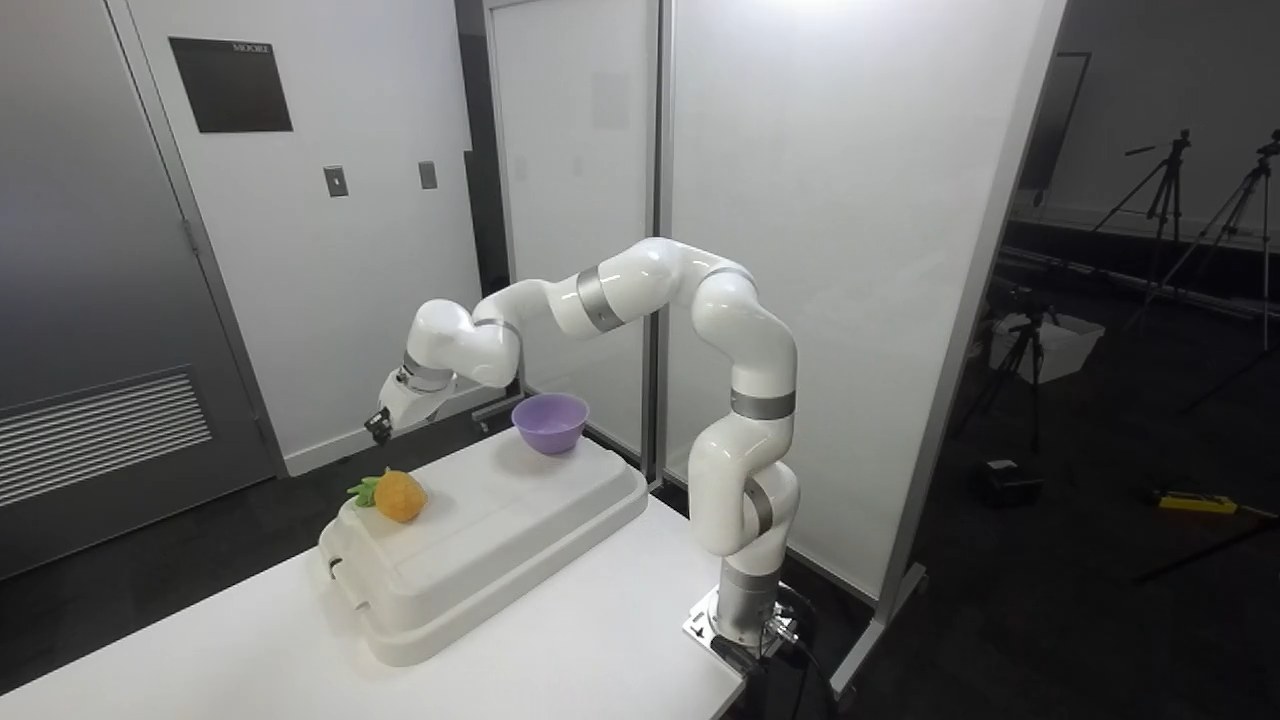
xArm7 · pineapple
Still frame from this slide’s video
xArm7 · stack cubes
Still frame from this slide’s video
xArm7 · stack cups
Still frame from this slide’s video
YAM · stack cubes
Still frame from this slide’s video
YAM · pick pens
Still frame from this slide’s video
YAM · insert cups
Still frame from this slide’s video

(a) xArm7 — 100 rollouts / task

%P&PSt.CuSt.CupAvg.
GR00T N1.730.07.07.014.7
$\pi_{0.5}$42.012.014.022.7
Ours67.028.034.043.0

(b) YAM — 20 evals / task

%St.CuPickPenInsertCup
GR00T N1.502015
$\pi_0$01015
Ours206050

xArm7: 43.0% vs. 22.7% average success; both new arms require target-arm adaptation.

PointAction — Tong, Jiang, …, Gu et al., arXiv 2606.03943

Can 3D help without retraining the model?

POINTACTION

Learn a 3D interface

Model weightsAdapted weightsθθ′ train Video + 3D supervision 3D point motion↓ robot actions

Update model weights.

Train / fine-tune RGB–XYZ prediction
and the point-to-action decoder.

3D is a learned intermediate representation.

OMNIGUIDE

Guide a fixed policy

Pretrained policyθ Weights fixedNo additional training Revise the action samplewith a 3D field

Update action samples.

Keep the pretrained VLA fixed;
steer its sampling with spatial gradients.

3D is an inference-time constraint.

3D can shape what a model learns and how a trained model acts.

Use 3D to check and refine an action

A VLA proposes actions; explicit spatial reasoning helps refine them.

VLA = Vision–Language–Action model · e.g., $\pi_{0.5}$ and GR00T N1.6

1 · PROPOSE

Pretrained VLA

candidate action

Images, instruction and robot state
condition a motion proposal.

→

2 · CHECK IN 3D

Spatial relationships

target errorclearance

Distance to the target?
Clearance from obstacles?
Alignment with a demonstration?

→

3 · REFINE

Adjust the action sample

spatial correction

Use spatial gradients to steer
the VLA’s action sampling.

Repeat while denoising · policy weights stay fixed

3D makes the constraints explicit and directly computable.

OmniGuide: steering actions with 3D fields

Yunzhou Song, Long Le, Yong-Hyun Park, Jie Wang, Junyao Shi,
Lingjie Liu, Jiatao Gu, Eric Eaton, Dinesh Jayaraman, Kostas Daniilidis

Original OmniGuide Figure 3: spatial trajectories and attractive, repulsive and combined gradients

Define an energy in 3D

$\mathcal L_y(X)$ scores a candidate Cartesian trajectory.

Turn it into a field

$F_y(X)=-\nabla_X\mathcal L_y(X)$

Attract toward a goal.
Repel away from obstacles.

The field lives in Cartesian space and guides generation in action space.

Robot time and denoising time

Execution time $t$

$A_t=[a_t,\ldots,a_{t+H-1}]$

One action chunk describes several future robot steps.

Sampling time $\tau$

$\frac{dA^\tau}{d\tau}=v_\theta(A^\tau,o)$

$A^0\sim\mathcal N(0,I)$ becomes clean $A^1$.

Guidance intervenes while the chunk is being generated. Each denoising step revises a candidate for the same future action sequence.

OmniGuide convention: $\tau=0$ noise, $\tau=1$ clean · $o$ collects the current policy context

Where do the 3D constraints come from?

SourceEnergy, up to constantsGeometric effect
Scene geometry$\mathcal L_C(x)=-\log\mathrm{SDF}(x)$
Within $0<\mathrm{SDF}(x)\le d$
Repel robot probes from nearby obstacles.
Semantic target$\mathcal L_S(x)=\frac{\|x-x^*\|^2}{2\sigma_S^2}$VLM pointing + depth gives a metric 3D goal $x^*$.
Human motion$\mathcal L_H(X)=\frac{1}{2\sigma_H^2}\sum_{(i,k)\in M}\|x_i-h_k\|^2$Attract matched robot poses to a reference wrist trajectory.

All three score a clean Cartesian trajectory $X$.

Collision point clouds exclude the robot body and task-relevant objects. Human matching progresses forward in the demonstration.

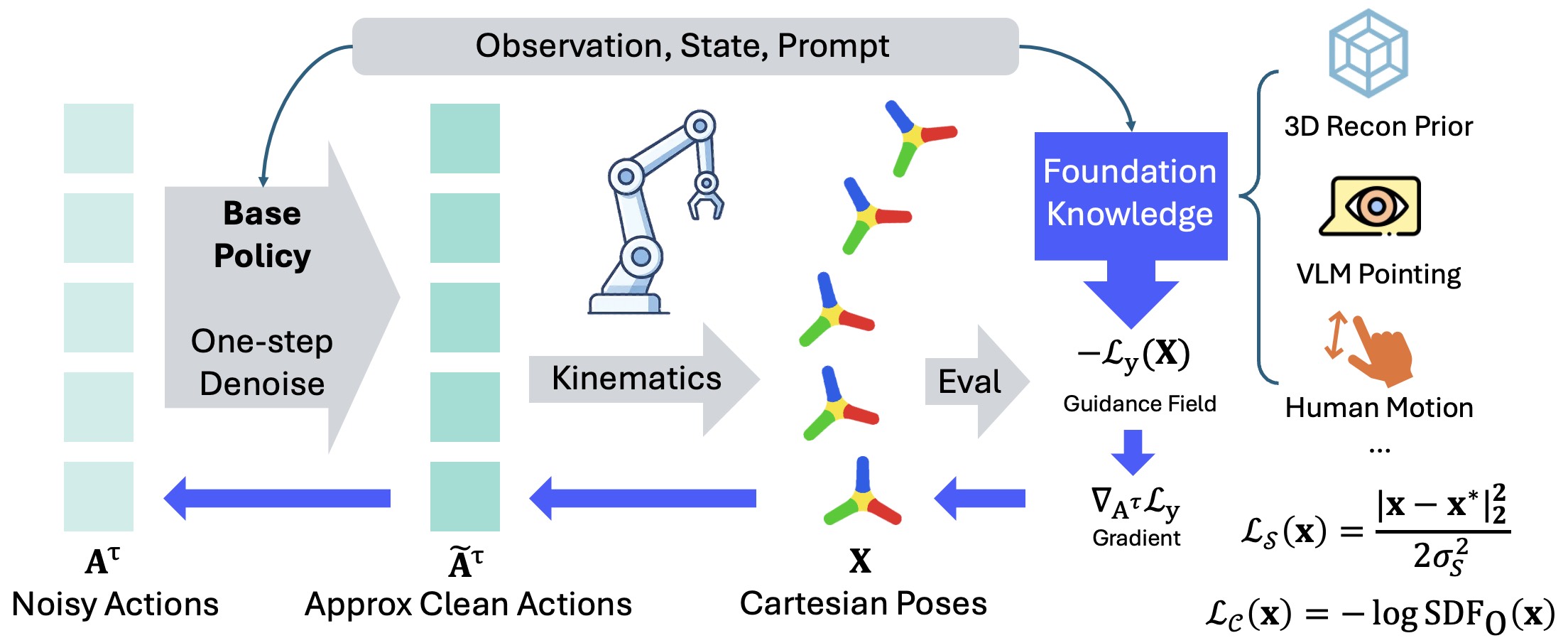
Using a 3D field to guide denoising

OmniGuide official full method overview: clean action estimate, kinematics and guidance
1. Estimate a clean plan.
$\widetilde A^\tau=A^\tau+(1-\tau)v_\theta(A^\tau,o)$
2. Evaluate its Cartesian trajectory.
Decode actions, apply dynamics / kinematics, and compute $\mathcal L_y(X)$.
3. Change the sampling velocity.
$v_{\rm guided}=v_\theta-\lambda\,\mathrm{clip}(\nabla_{A^\tau}\mathcal L_y)$

The gradient changes the action sample; policy weights stay fixed.

Backpropagating a spatial correction to the action

The same OmniGuide method diagram: forward prediction from noisy actions to Cartesian poses, and blue gradient arrows back to the action sample
Forward: evaluate the plan

Action sample → clean estimate → Cartesian poses → energy.

Backward: follow the blue arrows

Pass the spatial gradient through the robot mapping and the policy’s input.

$\nabla_{A^\tau}\mathcal L_y=\left(\frac{\partial\widetilde A^\tau}{\partial A^\tau}\right)^\top\left(\frac{\partial q}{\partial\widetilde A^\tau}\right)^\top\left(\frac{\partial X}{\partial q}\right)^\top\nabla_X\mathcal L_y$

Differentiate the action sample. The pretrained weights stay fixed.

Use the same 3D cost to select a starting seed

Before full denoising, compare a few short previews of possible plans.

SELECT · initialization guidance REFINE · denoising guidance Seed 1 → previewSeed 2 → previewSeed 3 → preview Higher spatial costLowest cost → selectHigher spatial cost From the selected seed Full denoising + gradient corrections Illustrative previews · obstacle = box · target = circle · no measured scores
Select. Short rollouts rank $N$ random seeds by $\mathcal L_y(X)$.
Refine. The same cost supplies gradients throughout full denoising.

Next: compare selection, refinement, and both.

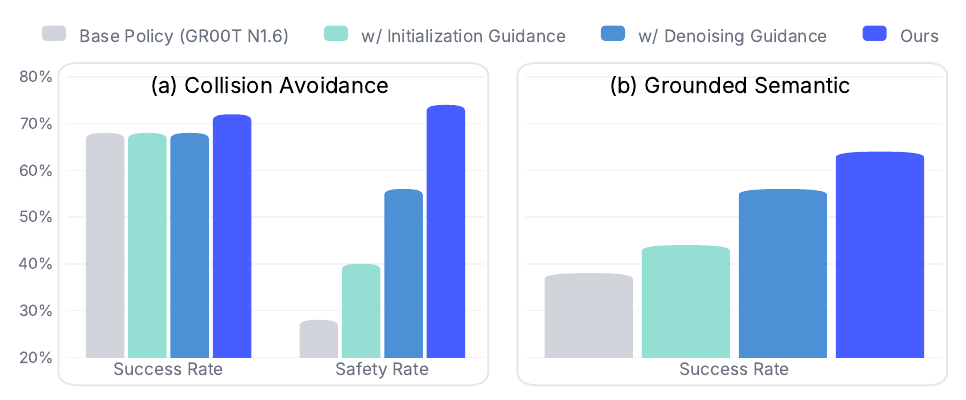
Selection and refinement work together

Compare seed selection, denoising refinement, and their combination.

Base

No spatial guidance

Select only

Initialization guidance

Refine only

Denoising guidance

Both

Select, then refine

Official OmniGuide Figure 5: gray is base policy, mint is seed selection only, blue is denoising refinement only, and violet combines both

Refinement gives the larger gains; combining both performs best in this comparison.

RoboCasa + GR00T N1.6-3B · 50 trials per setting · ground-truth depth and object poses

Reaching the goal while avoiding obstacles
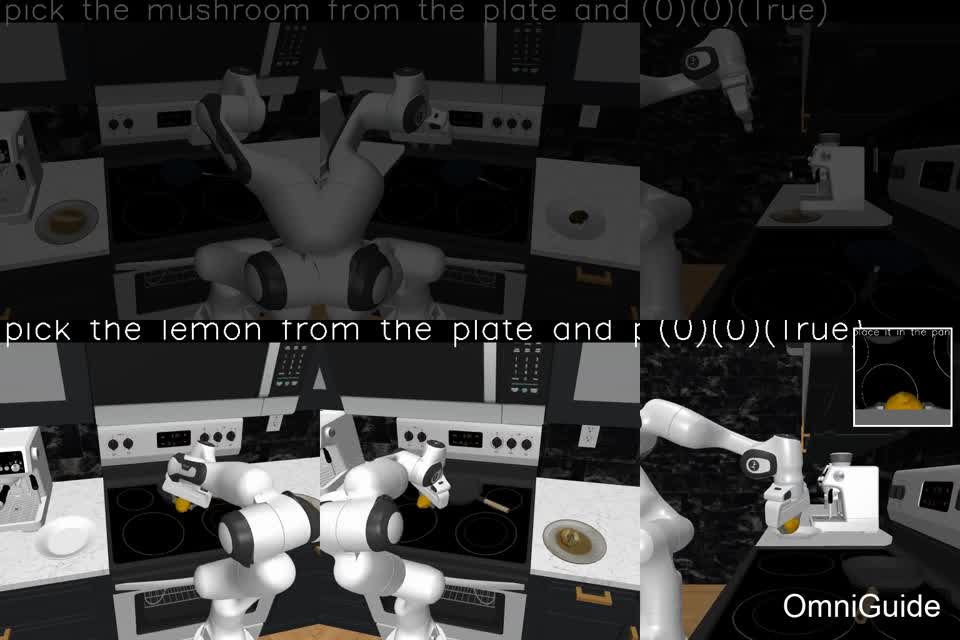
Still from the official combined-guidance simulation video
Official combined-guidance demo · RoboCasa
Semantic target + cluttered workspace
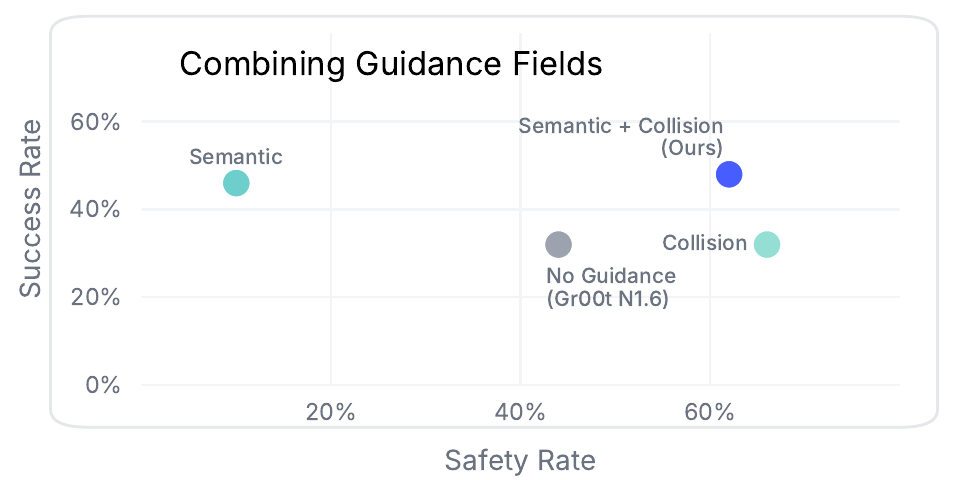
OmniGuide Figure 8: success versus safety for semantic-only, collision-only, and combined guidance

Combined guidance gives the best task success here. Collision-only guidance retains slightly higher safety.

$\mathcal L(X)=w_C\mathcal L_C(X)+w_S\mathcal L_S(X)$

One 3D trajectory, with both spatial objectives guiding its generation.

Improving a policy without retraining it
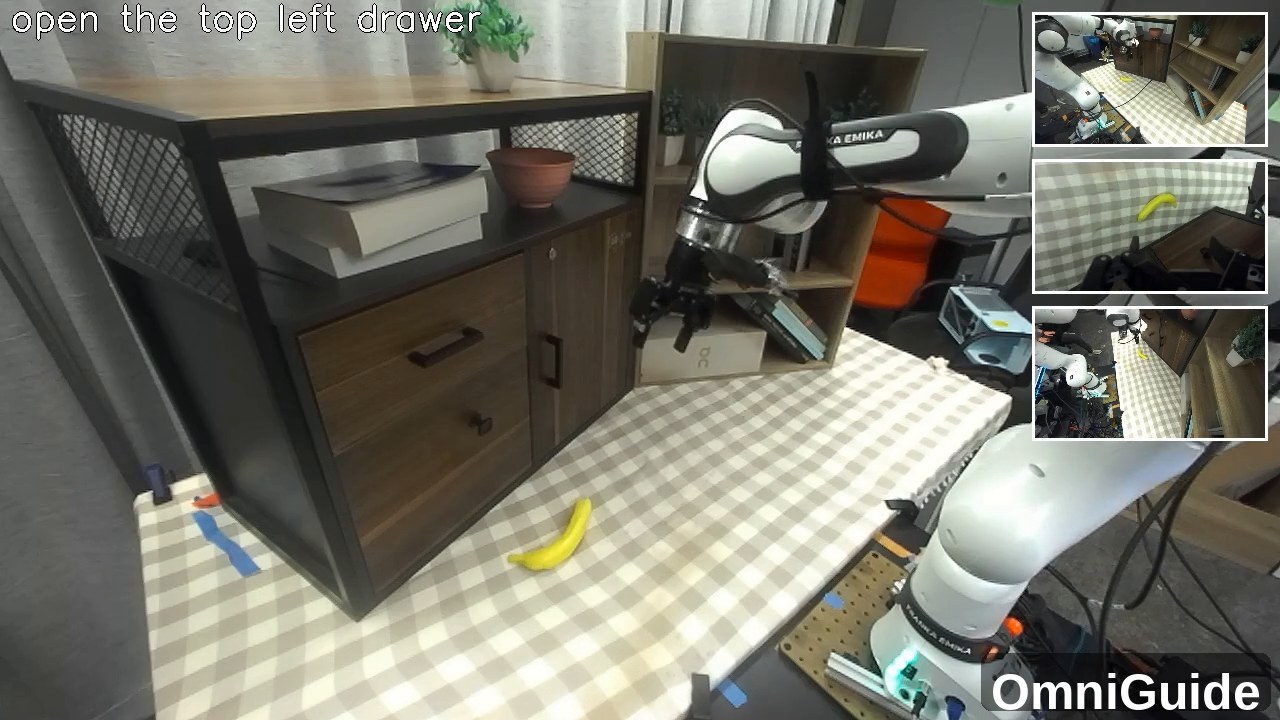
Still frame from this slide’s video
Real Franka robot · human-trajectory guidance
“open the top left drawer”
Aggregate metricBaseGuided
Success24.2%92.4%
Collision avoidance7.0%93.5%

Published cross-setting aggregates, not the success rate of this one video.

Cost: roughly 2× the inference time. Reported control frequency: ~30 Hz to ~15 Hz.

Local spatial objectives still depend on perception, calibration, and a useful policy prior.

FUTURE DIRECTIONS

What’s the future of 3D and world models?

An agent that anticipates change, compares action consequences, and learns from new evidence.

PointAction · motion interface

World prediction → 3D motion → control

OmniGuide · spatial feedback

3D constraints → gradients → actions

World statepersist + updatePredictActObserveOne evolving worldProposed direction

Can spatial reasoning become a persistent part of the model?

Research outlook · PointAction and OmniGuide are two concrete interfaces; the integrated system remains a direction to explore

World models beyond video generation

An agent’s ability to predict how the world changes and what its actions will cause.

What I know nowObservations + history World modelAnticipate consequences Candidate action If I do A …Possible outcomeIf I do B …Possible outcome Illustrative action-conditioned predictions
The state can be latent.

Preserve what matters for predicting change.

The prediction should inform action.

Anticipate consequences before acting.

Actions condition predictions; predictions guide actions.

Ha & Schmidhuber · World Models, 2018 · Hafner et al. · DreamerV3 · Agent-centered framing for this talk

FUTURE DIRECTIONS

Three questions remain open

How do we represent the world?

Pixels, latents, objects, geometry, or a hybrid?

What should the state preserve?

How do we predict change?

action + uncertainty

Autoregression, diffusion, flows, or structured dynamics?

How do errors accumulate over time?

How does prediction guide action?

Planning, policy learning, or inference-time guidance?

Which predictions matter for decisions?

Where can 3D make these choices more effective or efficient?

Research questions · representation, predictive model, and action interface are separate design choices

FUTURE DIRECTIONS · 1. STATE / MEMORY

Use 3D knowledge to build a latent world state
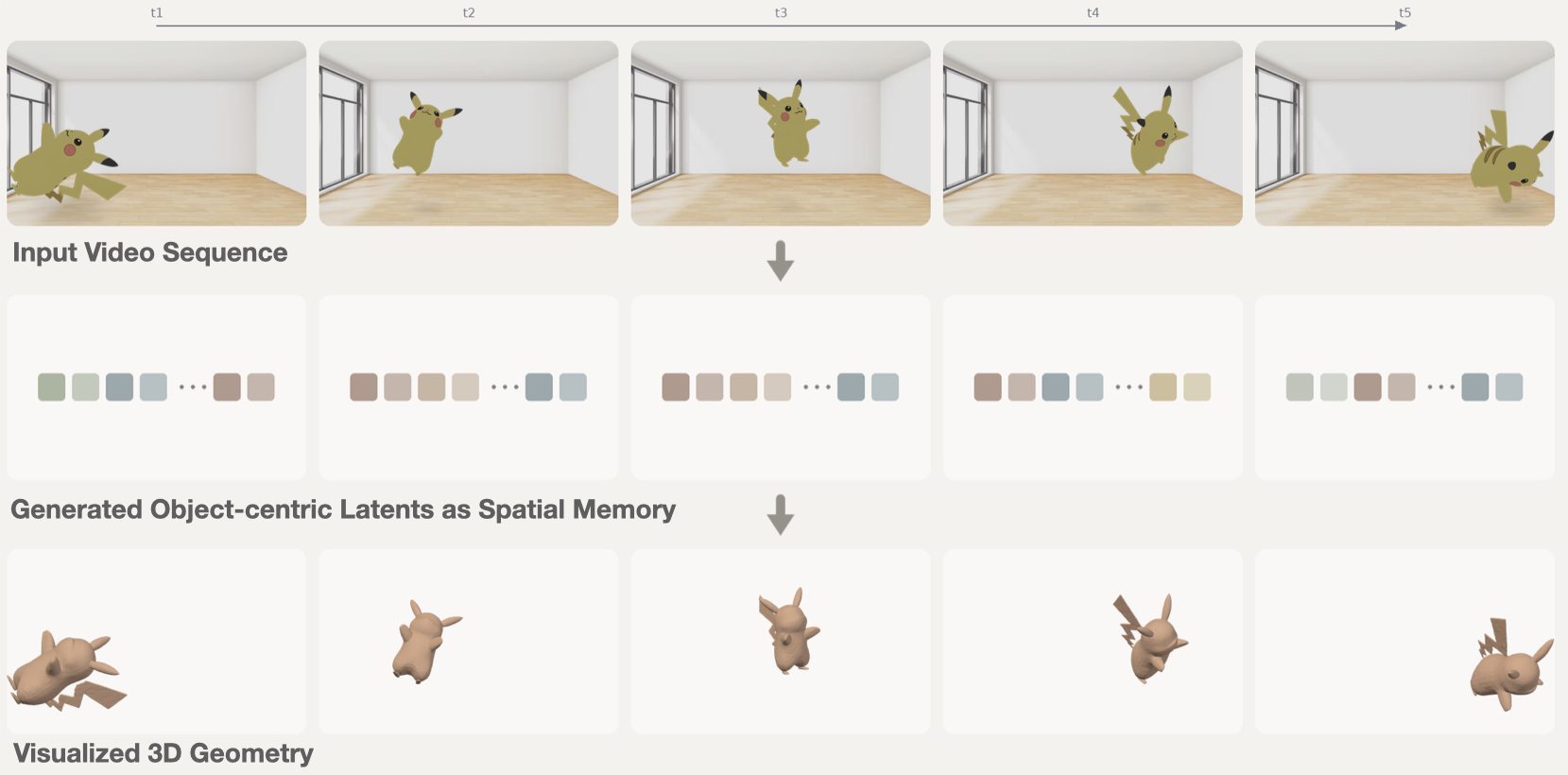
Pikachu prototype: input video is encoded into object-centric latent tokens, with reconstructed 3D geometry visualizing what the representation contains
Reuse existing 3D knowledge

Encode observations into compact, spatially meaningful latents.

Carry state into prediction

Preserve object identity, geometry, relations, and motion.

Then learn what should persist, what should change, and what remains uncertain.

The geometry visualizes the representation. The state itself can stay latent.

Jiatao Gu · RQ2.2 preliminary representation prototype · persistent fusion, identity tracking and memory-guided prediction are research directions

FUTURE DIRECTIONS · 1. STATE / MEMORY

Maintain a state as the world changes

Keep stable structure, represent uncertainty, and revise the state when new evidence arrives.

Observed nowOutside the viewObserved later Estimate geometry and object stateRetain state + uncertaintyRevise the changed object→→
Reuse

Stable spatial structure

Track uncertainty

What is no longer observed

Update locally

What new evidence changes

Research questions: memory growth · update cost · consistency over long interactions

Conceptual illustration of a research target · persistence and uncertainty handling require estimation, tracking, and update mechanisms

FUTURE DIRECTIONS · 2. LEARNING TO PREDICT

How do we learn changes in this state?

Current spatial state

$z_t$

Geometry · objects · uncertainty

→
Conditional dynamics

$p_\theta(z_{t+1}\mid z_t,a_t)$

Action-dependent possible futures

→
Predicted state

$z_{t+1}$

For planning and control

Here $z_t$ summarizes the available history; this is a proposed modeling interface.

Learn a distribution

Represent several plausible outcomes.

Extend through time

Reuse the predictor as state evolves.

Make prediction affordable

Evaluate candidate actions repeatedly.

Next: what the STARFlow family offers as generative foundations.

Research direction · normalizing flows are one modeling route; learning dynamics over persistent 3D latents remains to be explored

FUTURE DIRECTIONS · GENERATIVE FOUNDATIONS

STARFlow: sampling with a tractable density

A foundation for learning distributions over compact representations.
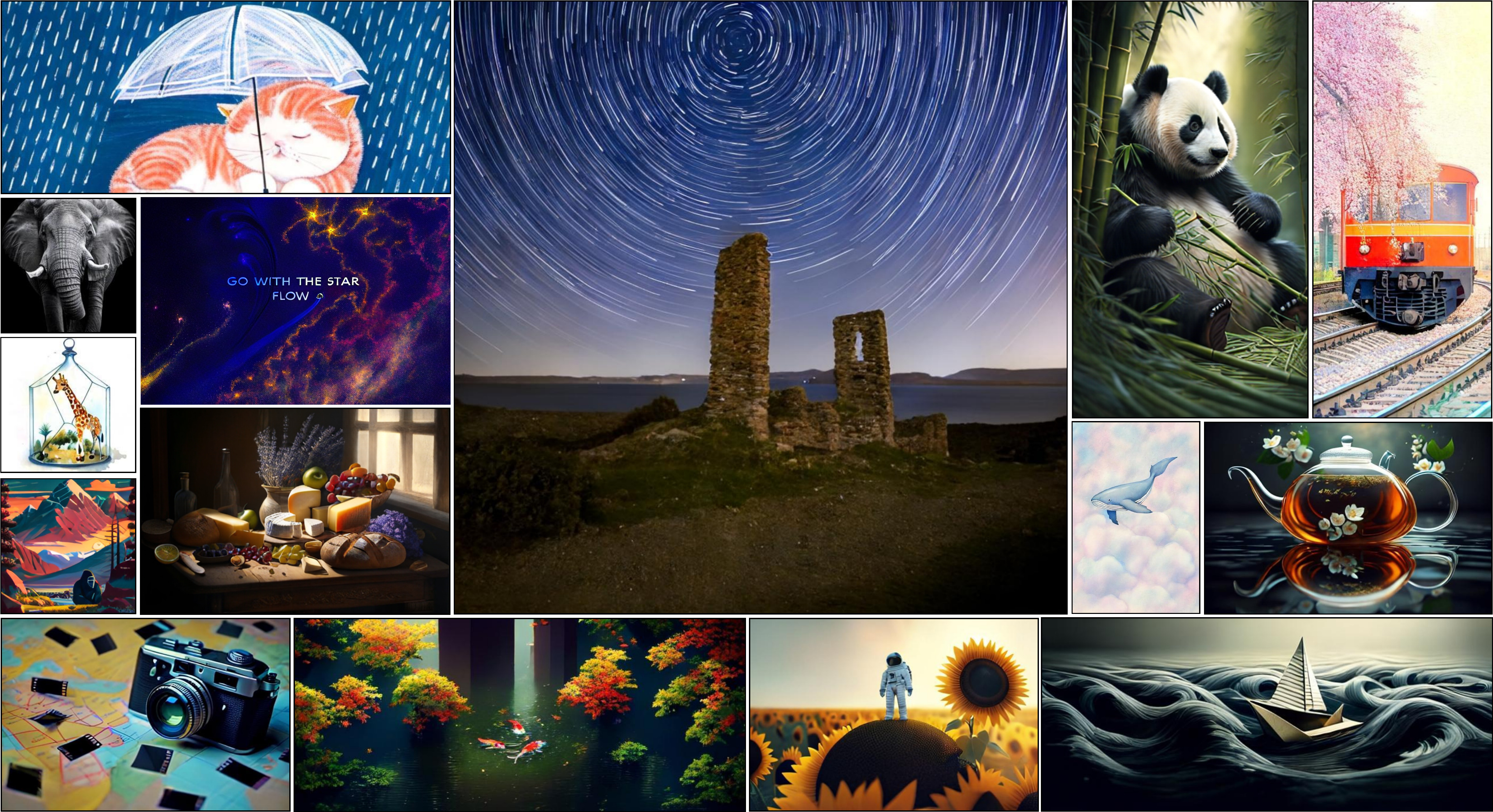
STARFlow
Scalable capacity. One deep Transformer block carries most capacity + a few efficient shallow blocks.
Compact modeling space. Model compressed autoencoder features to scale image generation to high resolution.
Sampling and density evaluation. An invertible flow supports sampling and exact density in its noisy latent space. The full image model uses an ELBO.
STARFlow: Scaling Latent Normalizing Flows for High-resolution Image SynthesisJ. Gu, T. Chen, D. Berthelot, H. Zheng, Y. Wang, R. Zhang, L. Dinh, M. Bautista, J. Susskind, S. Zhai · NeurIPS 2025 (Spotlight)

FUTURE DIRECTIONS · GENERATIVE FOUNDATIONS

STARFlow-V: extend the model through time
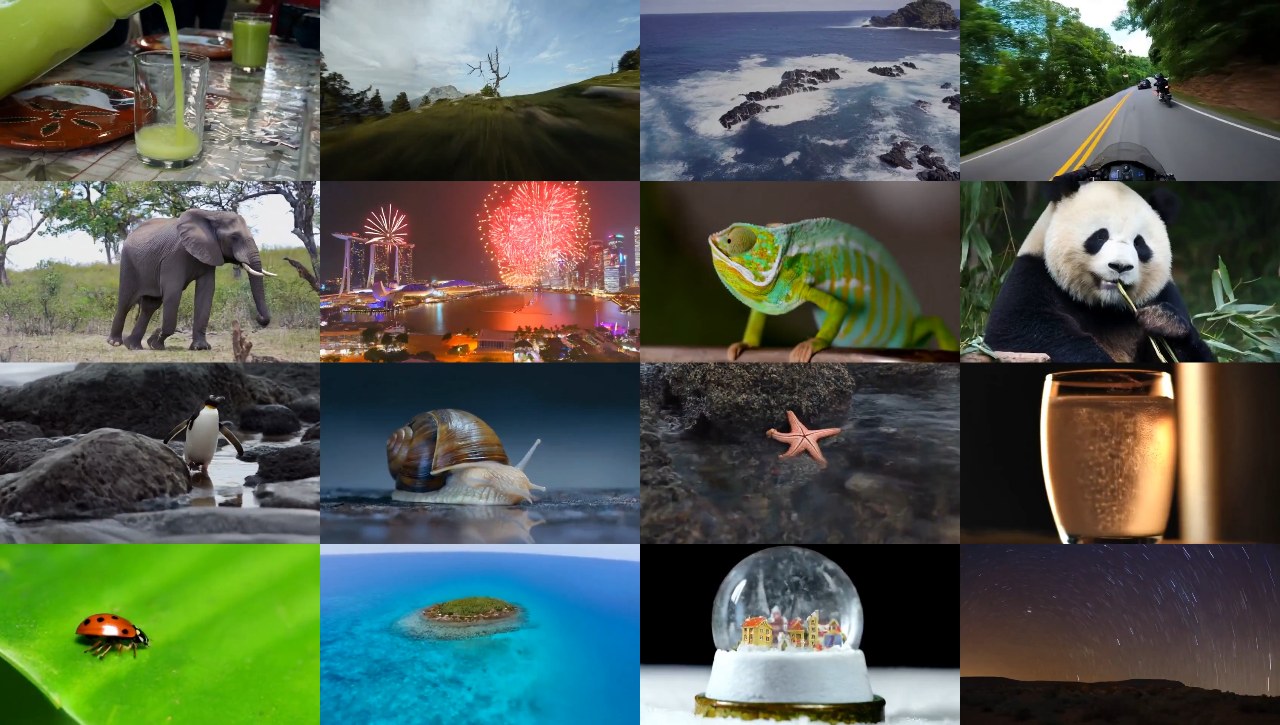
Still frame from this slide’s video
STARFlow-V · generation examples
Temporal factorization. A deep autoregressive flow carries temporal context; shallow flows model each frame.
Likelihood-based learning. The flow models compressed video latents. A separate causal denoiser refines visual detail.
Next: state transitions. Extend the framework with actions and spatial state, beyond visual continuation.

ONGOING

World-model planning with STARFlow

Use an action-conditioned rollout model to compare possible futures.
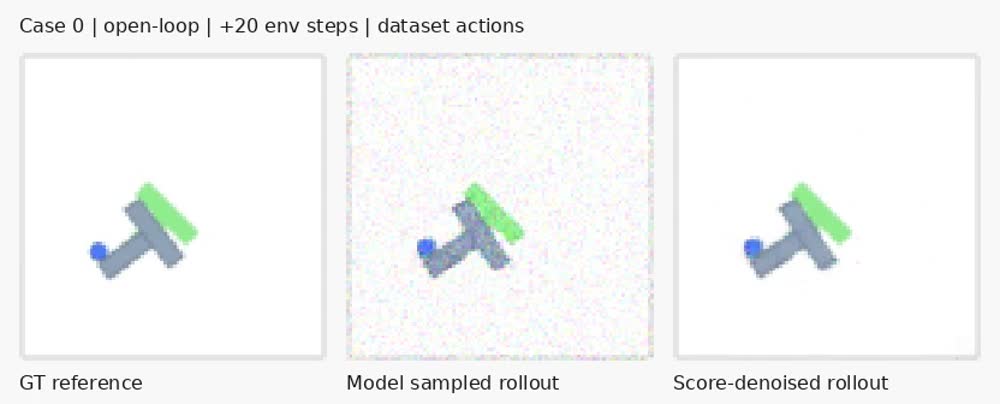
User-supplied preliminary STARFlow rollout video showing ground truth, a model sample, and a score-denoised sample under dataset actions
Preliminary rollout example · ground truth / sampled prediction / score-denoised prediction
Candidate actions → STARFlow rollouts → task objective → select an action → replan

Video: open-loop prediction under dataset actions. The loop above describes the planning direction.
Ongoing work · video supplied by Jiatao Gu · task desirability is evaluated by a task objective, not by model likelihood alone

FUTURE DIRECTION · CONNECTING MEMORY AND PREDICTION

Explicit memory, implicit world model

Read a persistent spatial state, predict action consequences, then update it with new evidence.

3D state / memory Identity · pose · latent features Persistent, structured, updatable LeWM / STARFlow Learned latent dynamics State + action → predicted change Imagined future state Evaluate candidate consequences Read statePredict updates Candidate actions Plan → act → observe → update the memory
A shared interface

Align spatial state with model latents.

Learn state changes

Predict object and relation updates.

Correct with observations

Track uncertainty and revise errors.

An architecture to explore: learn the read / update interface and test long-term consistency, control, and cost.

Proposed integration · LeWorldModel (LeWM) and STARFlow are candidate dynamics families; the combined 3D-memory system is not a reported result

One last example

Preview of Roberto Nickson’s linked video

Roberto Nickson · September 9, 2026

Thank you

3D as internal reasoning for world models and action.

PointAction · OmniGuide (CoRL 2026) · STARFlow / STARFlow-V

https://jiataogu.me
scan for more
jiataogu.me
Jiatao Gu · GMLR · Penn

Appendix: clean and noisy histories

$z^{\rm joint}=\mathrm{WidthConcat}\!\left(\mathcal E(o),\mathcal E(u_{xyz})\right)$

Future target

$\tilde z_\tau=(1-\tau)\tilde z+\tau\epsilon$

Predict the velocity $\epsilon-\tilde z$.

History conditioning

Randomize the observed prefix length $m$ and its noise level $\tau'$.

With 50% probability, set $\tau'=0$ so the history is clean.

$\mathcal L_{\rm flow}=\mathbb E\!\left[\left\|v_\theta(\tilde z_\tau,\hat z_{\tau'},l,\tau)-(\epsilon-\tilde z)\right\|_2^2\right]$

PointAction convention: $\tau=0$ clean, $\tau=1$ noise · frozen VAE and text encoder, LoRA adaptation